
station() and leg() — a route through the score
Map mode's two cues. A station is a place the camera stays; a leg is
the move from one station to the next. Together they make a route that runs
on its own clock — in a map-mode project ("defaultViewMode": "map") it is
the piece's time, and the transport drives it. For the idea and how to work with it, see
Map Mode — Stations & Legs.
station(name:reef, stay:75, at:[0.667, 0.5], edge:reef-buoy, align:center)
  draw(start:penA, trig:manual)
  text(uid:reef-story, cycle:reef.txt, dur:4, trig:manual, tdelay:8)

leg(dur:8, lead:2) ui(uid:lighthouse-beam, visible:true, dur:4, trig:manual)
Neither is ever fired by the playhead, and neither are the other cues on their elements: the route runs them.
Changing a route
- Times — the route table. Open the route table and click ✎ edit:
every station's
stay:anduntil:, and every leg'sdur:, become fields. Type a value, press Enter, and it is written to the score. The quickest way to retime a piece; see Changing the times. - Other parameters — the DSL editor. Tick show on map in the route
table so the station rectangles and leg arrows can be clicked, turn on the
✏ pencil and click one: the parameters it already has (
at:,scale:,run:,lead:…) appear as fields. It offers no list of new ones to add — type those into the cue. - Drawing the route — Inkscape. Stations are rectangles and legs are connector arrows, so moving, resizing or reconnecting them is done there (see Drawing a route).
station()
Put it on a rectangle drawn around what the camera should see there. The camera fits the rectangle on arrival.
| Parameter | Meaning |
|---|---|
name |
The station's name, used by legs and the route table. Default: the element's id. |
stay |
Beats the camera stays, or quoted minutes and seconds of beats: stay:85, stay:"1:25". With until:, the longest it waits. A last station without one holds the view until the route is stopped. |
until |
A gate: the stay ends when it opens. until:click waits for a performer (a continue ▸ button appears); until:"click:<id>" for a click on that element of the score. Anything else is a condition on a signal, quoted: until:"buoy.end", until:"adc.onset>0.5". |
start |
start:1 — the route begins here. Default: the first station no leg arrives at. |
pause |
Scroll scores: pause:1 — the score's playback holds for the stay (released when the station is left). Map mode has no playback to hold. |
run |
run:<id> or run:[<id>, <id>] — on arrival, run the cue that element carries, as next:<id> would. For cues that must stay on their own element (o2p(), text(target:self)). |
state |
state:[<uid>, …] — what this station expects to be visible. Applied when the route jumps here (see below). |
scale |
A zoom level, instead of fitting the rectangle. |
to |
Follow this element instead of the rectangle's centre. |
at |
[x, y] — where on screen the target lands, as fractions of the view. Default [0.5, 0.5]. |
edge |
<id> — the playhead line arrives just before this element (or through its centre with align:center). |
align |
With edge: center. |
playhead |
<id> — the playhead line ends on this element. On pinned material the pin slides to bring it there. stay — the view moves without the playhead. |
hold |
Beats, or next: the camera stays locked on its target after arriving, as it is carried about. |
sweep |
sweep:0 — a pinned target stays pinned on arrival. |
margin |
With edge: the gap before the element, in score units. |
at, edge, align, playhead, hold, sweep and margin are passed to
the zoom() that makes the move.
The stay's cues
Every other cue on the station's element runs when the route arrives:
- at once, or after
tdelay:beats into the stay; - or when a quoted
trig:condition comes true during the stay —trig:"story.line==5"(a text reaching line 5),trig:"buoy.end", any signal condition. Atdelay:then counts from that moment.
Leaving the station ends what the stay set going: its texts, its cues still
waiting, its pause:1 hold.
Triggered by another cue
A station can be entered from outside the route: next:<station id> from a
chain, a button, or any cue that runs the element. The route starts there
and carries on. Only station() runs; the stay's cues are run by the route
on arrival, not twice.
leg()
Put it on an arrow drawn with Inkscape's connector tool from one station rectangle to the next; the connector's ends say which stations it joins.
| Parameter | Meaning |
|---|---|
dur |
Beats the camera move takes. Default 2; dur:0 is a cut. |
ease |
As for zoom(): easeInOutSine (default), linear, easeInOutCubic, easeOutCubic. |
lead |
Beats before the camera leaves that the leg's own cues start. After a gate, they start as it opens and the camera leaves lead beats later. |
from, to |
Station names or ids, instead of a connector's ends. |
Other cues on the leg's element start at lead before departure (plus any
tdelay: of their own) — typically revealing what the camera is about to
arrive at:
leg(dur:10, lead:2) ui(uid:reef-outline, visible:true, dur:4, trig:manual)
Jumps
Starting the route at a station — ▶ on a row of the route table, or a station triggered by a cue — is a jump. It puts back everything the route's stations and legs change:
- what they reveal or expect is shown only if the target's
state:lists it, or it was visible when the score loaded; - the pens their
draw()controls start are lifted and the ink wiped; - the elements they
run:go back to their start.
Then the camera cuts to the station and its stay begins.
Signals for waiting on
| Signal | Published by | Value |
|---|---|---|
<uid>.line |
text() |
the line showing: 1, 2, 3 …; 0 before the first and after the last |
<uid>.end |
text(), o2p() (finite loop:), audio(), stopwatch() (with hold:) |
0 as it starts, 1 when it reaches its end (not when stopped) |
Examples
A fixed stay, a text, a reveal on the way out
station(name:reef, stay:75, run:reef-story, edge:reef-buoy, align:center)
leg(dur:8, lead:2) ui(uid:lighthouse-beam, visible:true, dur:4, trig:manual)
Wait for a moving object to arrive, at most four minutes
station(name:drift, until:"buoy.end", stay:240, run:buoy, to:buoy, hold:next)
A performer decides when to move on
station(name:harbour, until:click)                   // continue ▸, bottom left
station(name:harbour, until:"click:harbour-bell")    // a click on the bell drawn there
A camera move inside a stay, on a line of its text
station(name:lighthouse, stay:128, run:keeper-story)
  zoom(to:lamp, scale:40, dur:4, trig:"keeper-story.line==5", tdelay:1)
Demo project
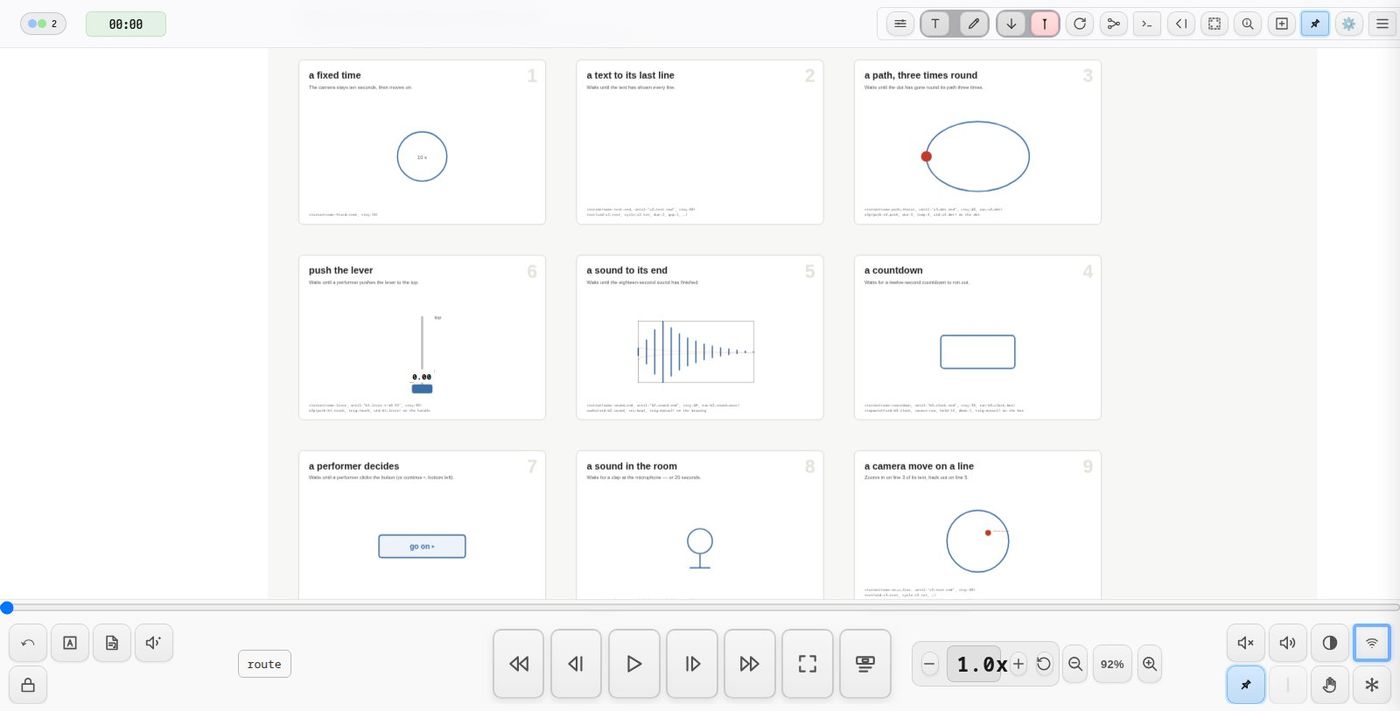
demo-map shows every kind of gate on a 3×3 grid; see Map Mode.
The end of the route
station(name:coda, at:[0.5, 0.5], hold:next)
No stay: and no leg out: the view holds until the route is stopped.
Tip: use ← → or ↑ ↓ to navigate the docs